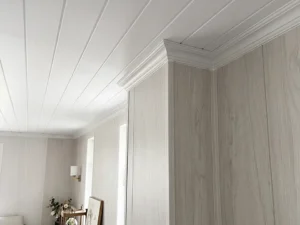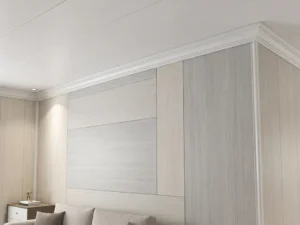

When sourcing ceiling finishing profiles internationally, buyers and contractors frequently encounter the terms PVC cornice and PVC crown molding used interchangeably. However, in the PVC building materials industry, these two terms represent fundamentally different structural designs, installation methods, and regional market standards.
Choosing the wrong category can result in ordering decorative moldings that lack the receiving slots needed to hold suspended PVC ceiling panels.
1. Structural Design: Slotted Integrated System vs. Surface-Applied Trim
The primary technical distinction lies in how the profile interacts with the ceiling surface:
Slotted Hollow PVC Cornice (Ceiling Panel System Trim)
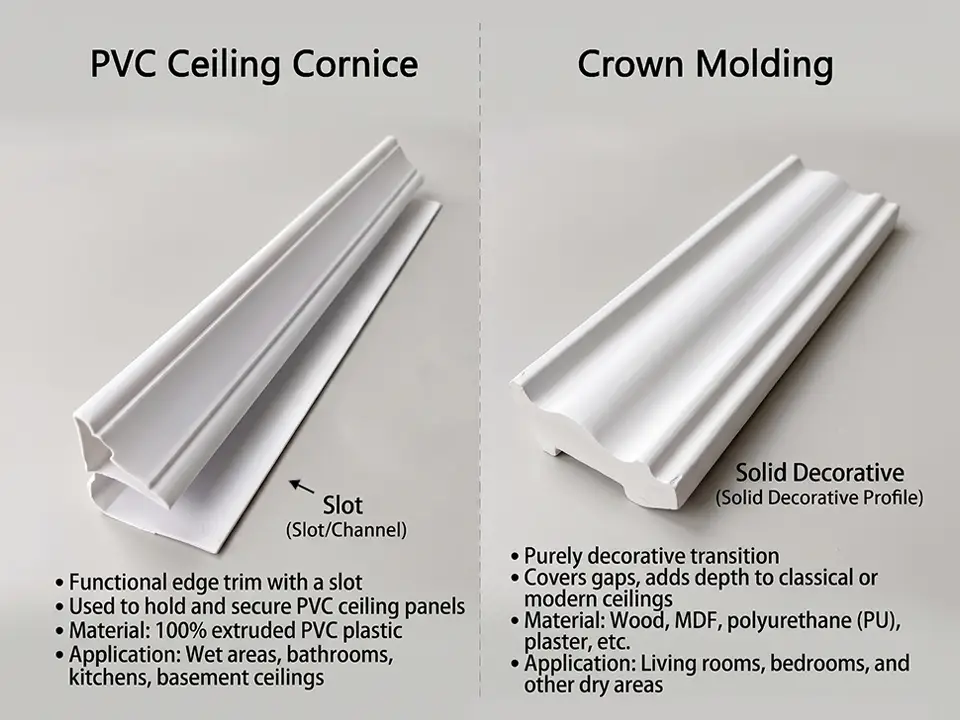
Engineered specifically as part of a tongue-and-groove PVC ceiling panel system, a PVC cornice features a hollow, multi-chamber decorative cove body integrated directly with a bottom J-channel receiving slot (6mm–12mm).
- Dual Purpose: It acts simultaneously as the structural perimeter edge receiver for the ceiling boards and the decorative wall-to-ceiling transition molding.
- Fastening: Fixed before the ceiling panels via a concealed rear nailing flange.
Architectural Cellular PVC Crown Molding
Traditional PVC crown molding is extruded from solid high-density cellular (foamed) PVC, mimicking traditional milled pine or MDF woodwork.
- Single Purpose: It has no receiving slot. It is a purely decorative architectural trim sprung at a 38-degree or 45-degree angle between a finished drywall, plaster, or wood ceiling and the wall.
- Fastening: Installed after the ceiling is completely finished, using finish nails shot directly through the face of the molding into wall studs and ceiling joists, followed by nail-hole filling and caulking.
2. Side-by-Side Technical Comparison
| Feature / Specification | Slotted Hollow PVC Cornice | Solid Cellular PVC Crown Molding |
|---|---|---|
| Core Structure | Rigid hollow multi-chamber extrusion | Solid foamed cellular PVC |
| Integrated Panel Slot | Yes (6mm, 8mm, 10mm, 12mm slots) | No (flush angled back edges) |
| Installation Sequence | Installed before inserting ceiling panels | Installed after ceiling is finished |
| Fastener Visibility | 100% concealed (screwed via hidden flange) | Face-nailed (requires putty/caulking over nail holes) |
| Surface Finishes | White, wood grain lamination, gold/silver hot-stamping | Matte white (paintable with 100% acrylic latex paint) |
| Unit Weight (per meter) | Lightweight (120g – 280g/m) | Heavy (450g – 900g/m) |
| FOB Cost Efficiency | High (low material weight & high container volume) | Moderate to high (dense foam extrusion) |
| Primary Regional Markets | UK, Australia, Middle East, Africa, Latin America, Asia | United States, Canada (residential interior/exterior trim) |
3. Two-Piece Clip-On Cornice: Bridging Both Worlds
What if a contractor wants the effortless panel installation of a surface-applied crown molding without visible face nails? The solution is the Two-Piece Clip-On PVC Cornice:
- The installer fixes an L-shaped base track around the perimeter and installs all PVC ceiling panels right up to the wall.
- The decorative hollow PVC cornice face snaps directly onto the base track after the last panel is secured. This eliminates the struggle of sliding the final ceiling board into a fixed perimeter channel while maintaining 100% concealed fasteners.
4. Which One Should You Specify or Stock?
- Order Slotted Hollow PVC Cornice if: You are distributing PVC ceiling panels (soffit panels, bathroom cladding, or commercial ceiling boards) and need a matching all-in-one perimeter trim that requires zero painting or caulking.
- Order Solid Cellular PVC Crown Molding if: You supply lumberyards, millwork distributors, or carpentry contractors installing trim over standard drywall, plasterboard, or exterior porch eaves.
- Explore all perimeter and joining options in our overview of PVC Ceiling Trim Types.
- Compare PVC against MDF, wood, and polystyrene in PVC Ceiling Trim Material Comparison.
Source Both Slotted Cornices and Cellular Moldings from One Manufacturer
Whether your market demands hollow slotted PVC cornices or solid cellular architectural crown moldings, we extrude both product lines to custom specifications.
Contact us for samples and wholesale pricing.
Frequently Asked Questions
Is PVC cornice the same as PVC crown molding?
No. In building material specifications, a PVC cornice is a multi-chamber hollow profile with an integrated bottom J-slot designed to hold tongue-and-groove PVC ceiling panels. PVC crown molding is a solid cellular (foamed) architectural trim without a slot, nailed over finished drywall or wood ceilings.
Can you install solid cellular PVC crown molding with hollow PVC ceiling panels?
Yes, but only as a secondary decorative layer. Because solid cellular crown molding lacks a panel-receiving slot, installers must first finish the panel edges with a basic J-trim or perimeter batten, and then brad-nail or glue the solid crown molding over the junction.
Do you need to paint or caulk slotted PVC cornice?
No. Slotted hollow PVC cornices come pre-finished in satin white, high-gloss, wood grain, or metallic hot-stamped patterns, and fasten via concealed rear flanges. Unlike cellular crown molding, there are no exposed face nail holes to fill, sand, or paint.
Which is more cost-effective for commercial projects: PVC cornice or cellular crown molding?
Slotted hollow PVC cornice reduces total installed costs by 40% to 55% compared to cellular crown molding. Its hollow multi-chamber structure uses less raw material weight per meter and eliminates on-site caulking and painting labor.