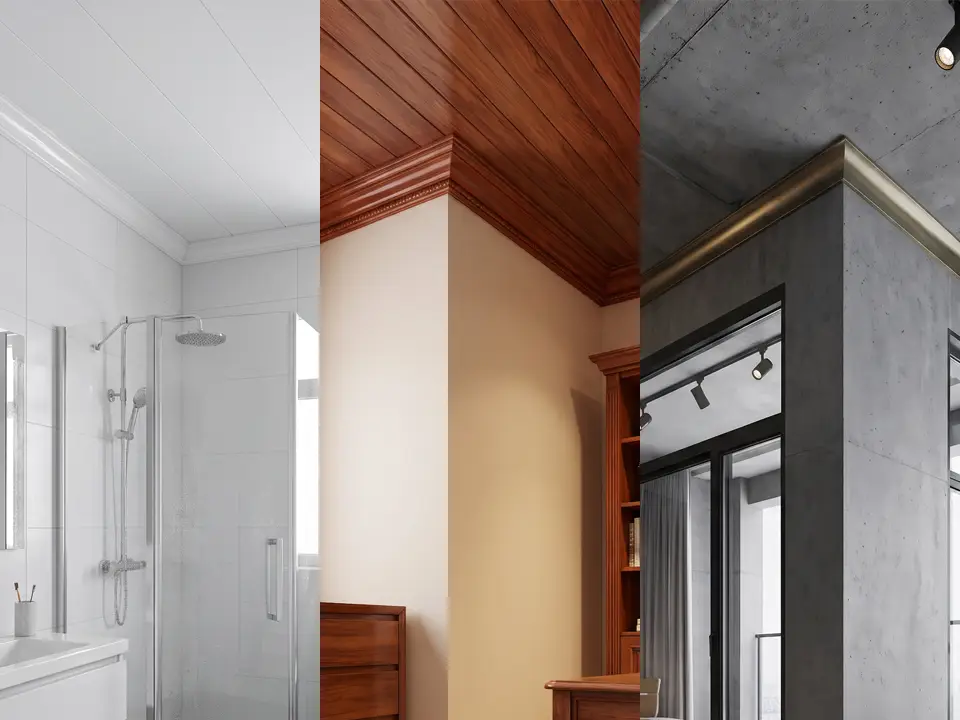

When building a product catalog or specifying materials for large-scale residential, hospitality, or healthcare developments, procurement managers must weigh initial material cost against lifecycle maintenance. Comparing PVC ceiling trim against wood, MDF, polystyrene (PS), and aluminum reveals why rigid cellular and hollow extruded PVC have captured dominant market share in modern interior construction.
1. Comprehensive Material Performance Matrix
| Evaluation Metric | Extruded PVC Trim | MDF (Medium Density Fiberboard) | Solid Timber / Pine | Polystyrene (PS / Foam) | Extruded Aluminum |
|---|---|---|---|---|---|
| Water & Humidity Resistance | 100% Waterproof (Zero swelling) | Poor (Swells, delaminates in >70% RH) | Moderate (Warps, cups, rots if unsealed) | 100% Waterproof | 100% Waterproof |
| Termite & Pest Resistance | 100% Immune | Vulnerable in tropical zones | Highly vulnerable | Immune | Immune |
| Integrated Panel Slot Capability | Yes (Complex multi-chamber slots) | Difficult / Costly to mill thin slots | Difficult / Prone to splitting thin lips | No (Too brittle to hold heavy panels) | Yes |
| Impact & Dent Resistance | High (Spring-back memory) | Moderate | High | Very Low (Dents with fingernail) | High (Can dent permanently) |
| On-Site Finishing Required | Zero (Pre-finished white/wood/foil) | Requires priming, caulking & 2 paint coats | Requires sanding, staining/painting | Requires painting & joint filling | Zero (Anodized or powder-coated) |
| Relative Material Cost (FOB) | $ (Low – Moderate) | $$(Moderate) \vert{}$$$$ (High) | $(Low) \vert{}$$$ (High) | ||
| Installed Total Cost (Material + Labor) | Lowest | High (Painting labor doubles cost) | Very High | Low – Moderate | Moderate – High |
2. Deep-Dive Comparisons by Competing Material
PVC Ceiling Trim vs. MDF & Solid Wood
For decades, primed MDF and finger-jointed pine were the default ceiling moldings. However, in bathrooms, kitchens, coastal resorts, and tropical climates (Southeast Asia, Latin America, West Africa, and the US Gulf Coast), MDF absorbs ambient moisture through unsealed cut ends, swelling into unsightly ridges within 12 to 24 months.
- The PVC Advantage: Extruded PVC is completely hydrophobic and impervious to termites. Furthermore, while wood and MDF cannot be economically milled with thin, flexible 6mm–10mm panel-receiving channels without snapping along the wood grain, PVC extrudes complex slotted profiles effortlessly.
PVC Ceiling Trim vs. Polystyrene (EPS / High-Density PS)
Polystyrene foam cornices are lightweight and inexpensive, glued directly to drywall ceilings.
- The PVC Advantage: PS foam lacks structural tensile strength. It cannot incorporate a load-bearing J-channel to support suspended ceiling panels—if a panel weighs down on a PS lip, the foam shears off immediately. PVC delivers structural load support, higher fire-retardant performance (self-extinguishing UL94 V-0 / ASTM E84 Class A), and wipe-clean surface durability.
PVC Ceiling Trim vs. Aluminum Alloy Profiles
Extruded 6063-T5 aluminum perimeter channels are sometimes specified in industrial cleanrooms or high-heat boiler rooms.
- The PVC Advantage: Aluminum costs 2.5× to 4× more per linear meter than PVC, conducts heat and condensation (creating water drip lines in humid ceilings unless thermally broken), and cannot replicate warm 3D embossed wood-grain or classical ogee cornice profiles cost-effectively. Unless ambient ceiling temperatures exceed 60°C (140°F), rigid PVC offers superior aesthetics at a fraction of the landed cost.
3. Why Distributors Are Shifting Inventory to Extruded PVC
- Zero Warehouse Spoilage: Unlike timber or MDF, which warp if stored in non-climate-controlled warehouses during rainy seasons, PVC trims have an indefinite shelf life.
- Higher Container Profitability: Lightweight hollow PVC profiles allow importers to load 35,000 to 60,000 linear meters into a single 40HQ container (or co-load inside empty spaces around PVC ceiling panel pallets), slashing ocean freight cost per meter.
- See how PVC achieves realistic timber aesthetics in PVC Ceiling Trim Surface Finish Selection.
- Learn how we tailor formulations for your local climate in Custom PVC Ceiling Trim Manufacturing.
Upgrade Your Product Line with Maintenance-Free PVC Trims
Looking to replace warping MDF or fragile PS moldings in your distribution catalog?
Contact our export team today for a side-by-side landed cost comparison and free physical samples.
Frequently Asked Questions
Is PVC ceiling trim better than MDF for bathrooms and kitchens?
Yes. Extruded PVC ceiling trim is 100% waterproof and impervious to steam, condensation, and mold. MDF absorbs ambient moisture through cut edges and nail holes, causing it to swell, delaminate, and peel within 12 to 24 months in high-humidity rooms.
Why choose PVC ceiling trim over polystyrene (PS) foam cornice?
Unlike fragile polystyrene foam—which dents easily and cannot support mechanical weight—rigid extruded PVC provides structural load-bearing J-channels to hold suspended ceiling panels, superior impact resistance, and wipe-clean surface durability.
Does PVC ceiling trim turn yellow or brittle over time?
High-grade PVC ceiling trims compounded with rutile titanium dioxide (TiO2) UV stabilizers and lead-free Ca-Zn heat stabilizers maintain their color and flexibility for 15 to 25+ years indoors without yellowing or chalking.
How does the installed cost of PVC trim compare to wood or MDF molding?
Pre-finished PVC ceiling trim reduces total installed cost by 35% to 50% compared to timber or MDF. Because PVC requires zero priming, sanding, caulking, or multi-coat painting on site, contractors finish ceiling perimeters in a single pass.