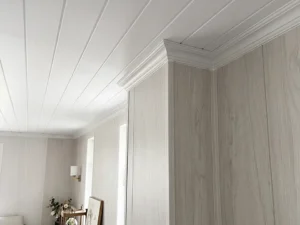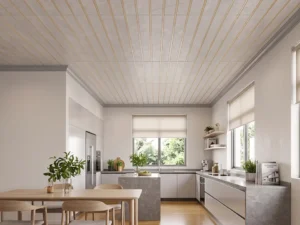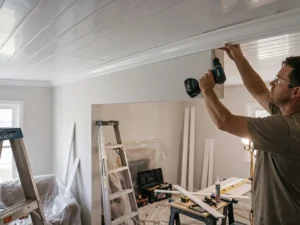

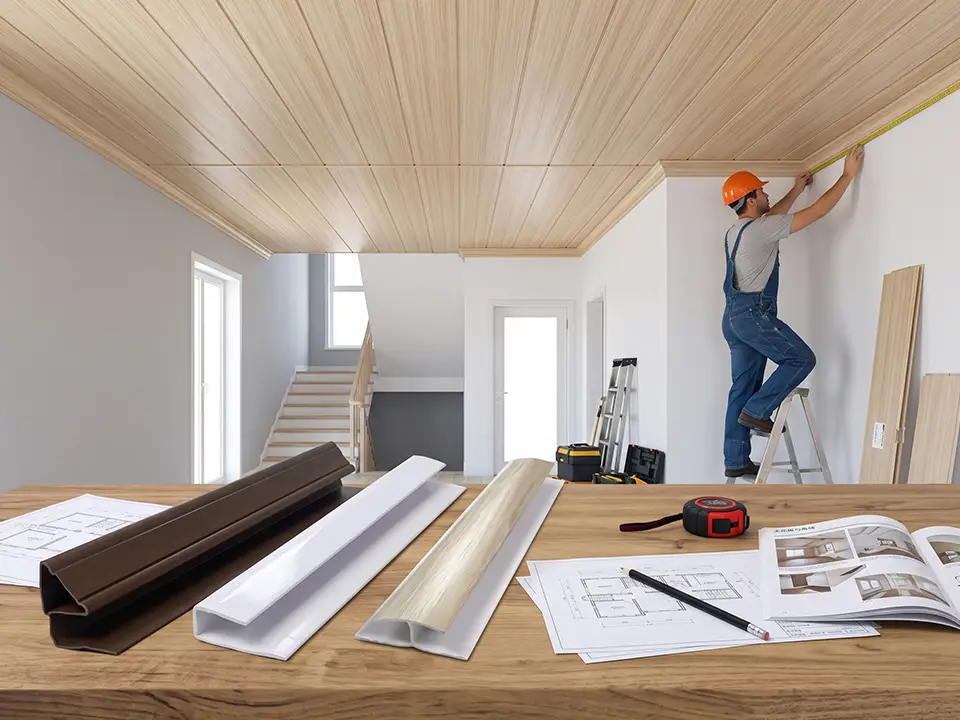
While two trims may look identical from below once installed, their internal PVC ceiling trim profiles determine how rigidly they hold heavy panels, how well they hide wavy wall substrates, and whether they sag over time in high-temperature spaces.
For B2B buyers, project specifiers, and OEM importers, evaluating the cross-sectional geometry and extrusion tolerances of a profile is the most reliable way to separate commercial-grade moldings from brittle, low-cost alternatives.
1. Internal Structural Geometry: Single-Wall vs. Multi-Chamber Hollow Profiles
PVC ceiling trims are manufactured via continuous profile extrusion, falling into two structural categories:
Single-Wall Solid Extruded Profiles
Used primarily for compact J-trims, H-trims, and L-angles, single-wall profiles consist of solid extruded PVC walls ranging from 0.8mm to 1.5mm in thickness.
- Key Engineering Detail: High-quality single-wall profiles feature a slightly angled (1°–2° inward) front lip. This creates spring tension against the face of the ceiling panel, preventing visible gaps even if the panel contracts slightly in air-conditioned rooms.
Multi-Chamber (Hollow) Box Profiles
Used for decorative cornice trims, wide crown profiles (50mm to 120mm face width), and heavy-duty commercial perimeter trims. Internal webbing divides the profile into multiple triangular or rectangular chambers.
- Rigidity-to-Weight Ratio: Internal ribs prevent torsional twisting during installation and stop the front lip from drooping under the weight of 10mm or 12mm panels.
- Thermal & Acoustic Buffering: The trapped air chambers reduce thermal bridging along exterior roof edges.
2. Critical Profile Dimensions & Slot Tolerance Engineering
The most critical dimension on any slotted PVC ceiling trim profile is the receiving channel width (Dimension 𝑊). If the slot is too tight, installers will crack the trim lip while forcing the panel in; if it is too loose, the panel will rattle or sag.
| Nominal Panel Thickness | Ideal Trim Slot Width ( ) | Front Visible Lip Width | Back Nailing Flange Width | Minimum Wall Thickness |
|---|---|---|---|---|
| 5mm – 6mm Panel | 6.3mm – 6.5mm | 12mm – 14mm | 22mm – 25mm | 0.8mm – 1.0mm |
| 7mm – 7.5mm Panel | 7.8mm – 8.0mm | 14mm – 15mm | 25mm – 28mm | 0.9mm – 1.1mm |
| 8mm – 8.5mm Panel | 8.5mm – 8.8mm | 15mm – 18mm | 25mm – 30mm | 1.0mm – 1.2mm |
| 9mm – 9.5mm Panel | 9.8mm – 10.0mm | 16mm – 18mm | 28mm – 30mm | 1.1mm – 1.3mm |
| 10mm – 12mm Panel | 10.5mm / 12.5mm | 18mm – 22mm | 30mm – 35mm | 1.2mm – 1.5mm |
Engineering Rule: Always specify a receiving slot clearance of +0.3mm to +0.6mm above the nominal thickness of your PVC ceiling panel. This accounts for protective PE film thickness, hot-stamping foil buildup, and extrusion tolerances.
3. Architectural Face Styles
Different regional markets demand distinct aesthetic silhouettes:
- Classic Ogee & Stepped Profiles: Featuring traditional S-curves and multi-stepped architectural lines, these profiles dominate residential renovation markets in Eastern Europe, Latin America, and the Middle East.
- Beveled & Contemporary Flat Profiles: Clean 45-degree chamfers or flat square edges designed for modern offices, retail stores, and modular prefabricated housing.
- Co-Extruded Soft-Lip (Flexible Edge) Profiles: Equipped with a soft, rubberized PVC gasket co-extruded along the wall-contact edge. When pressed against uneven brick, stone, or textured plaster walls, the flexible lip compresses to seal micro-gaps without caulking.
- Two-Piece Snap-Lock (Clip-On) Profiles: Engineered with a concealed mounting base and a detachable decorative cover. Installers screw the base track to the wall, slide the ceiling panels into place, and snap the front cover on last—speeding up installation by up to 30%.
4. Pre-Punched Nailing Flanges vs. Solid Flanges
When reviewing technical drawings with your manufacturer, check the back nailing flange:
- Slotted Nail Holes: Premium profiles feature elongated oval slots punched every 100mm along the back flange, allowing the trim itself to expand and contract horizontally without buckling around the fastener heads.
- Ribbed Back Surface: Micro-grooves extruded onto the rear face of the profile increase mechanical grip when installers use construction adhesives instead of mechanical screws.
- Compare how cornice profiles differ from traditional crown moldings in PVC Cornice vs Crown Molding.
- Need a proprietary profile developed for your brand? Explore our Custom PVC Ceiling Trim Manufacturing capabilities.
Request Our Full CAD Profile Catalog
Searching for specific slot sizes or decorative cross-sections? We maintain over 150 active extrusion dies ready for immediate production.
Download our PDF Profile Drawing Catalog send us your sample for a custom OEM match.
Frequently Asked Questions
What is the difference between hollow and solid PVC ceiling trim profiles?
Single-wall solid profiles (used for compact J-trims and L-angles) feature a single extruded wall 0.8mm–1.5mm thick. Multi-chamber hollow profiles (used for wide decorative cornices) contain internal structural ribs that prevent twisting, sagging, and deflection across wider 50mm–120mm profile faces.
How much clearance should a PVC ceiling trim slot have?
The receiving channel should be engineered 0.3mm to 0.6mm wider than the nominal thickness of the ceiling panel. For example, a 10mm commercial panel performs best with a 10.5mm slot, accommodating protective PE films and thermal expansion without binding.
What is the standard wall thickness of commercial-grade PVC ceiling trim?
Commercial-grade PVC ceiling profiles feature an external wall thickness of 1.0mm to 1.5mm and internal support ribs of 0.7mm to 0.9mm. Trims thinner than 0.7mm are prone to telegraphing fastener indentations and cracking in cold weather.
How do two-piece clip-on PVC ceiling profiles work?
A two-piece clip-on profile consists of a concealed PVC mounting track screwed to the wall or batten, and a snap-lock decorative front cover. Installers mount all ceiling panels first and snap the front cover into the base track last, eliminating final-panel bending.