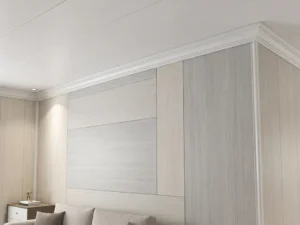


Knowing how to choose PVC ceiling trim goes far beyond picking a pattern that matches your ceiling panels. A poorly specified trim can yellow within six months, crack under pneumatic staple guns during winter installations, or arrive with noticeable shade variations against the main ceiling boards.
Whether you are sourcing full container loads (FCL) for regional distribution or specifying materials for a commercial hospitality project, use these seven technical criteria to evaluate and select the right PVC ceiling trim.
1. Match the Slot Width to Panel Thickness and Weight
Your first filter is mechanical compatibility:
- Standard Hollow Panels (5mm–8mm): Pair with standard single-wall J-trims or 35mm–50mm hollow cornice profiles with a 12mm–15mm front lip.
- Heavy Commercial & Soffit Panels (9mm–12mm): Require heavy-duty profiles with a minimum 1.2mm wall thickness and a deeper 18mm–22mm front lip. Deeper channels ensure that even when panels contract during winter, the cut edges never pull out of the trim slot.
2. Evaluate the PVC Resin-to-Calcium Carbonate Ratio
Not all PVC formulations perform equally. Extruded PVC trims are compounded primarily from Virgin PVC Resin (SG-5/SG-8), Calcium Carbonate (CaCO3) filler, impact modifiers (CPE), and heat stabilizers.
| Formulation Grade | PVC Resin Content | Physical Characteristics | Best Application |
|---|---|---|---|
| High-Resin (Flexible/Tough) | 60% – 75% PVC | High impact resistance; bends up to 90° without snapping; clean miter cuts | Cold climates, exterior soffits, commercial staple-gun installation |
| Standard Balanced Grade | 45% – 55% PVC | Rigid structure, smooth surface, optimal cost-to-performance balance | Residential interiors, offices, standard climate zones |
| High-Filler Economy Grade | 30% – 40% PVC | Heavy, hard, but brittle; prone to edge chipping if cut with dull blades | Budget housing projects in warm climates (adhesive installation) |
Field Quality Test: Squeeze the receiving slot of a J-trim or H-trim completely shut with pliers. A well-formulated trim (50%+ PVC resin) will crease slightly and spring back without fracturing or turning chalky white along the fold line.
3. Verify Color Matching and Surface Finish Compatibility
When buying panels and trims separately—or from different production batches—color mismatch (metamerism) is a major risk.
- Matte & High-Gloss White: Request the manufacturer’s CIE Lab Δ𝐸 color tolerance standard (ideally Δ𝐸<0.8 between panel and trim). Ensure both use the same rutile titanium dioxide (TiO2) UV package so one does not yellow faster than the other.
- Wood Grain & Marble Patterns: Always source your laminated or hot-stamped trims from the exact same factory producing your panels so the same batch of PVC decorative film or transfer foil is applied to both.
4. Check Fire Retardancy and Hygiene Certifications
Commercial tenders for hospitals, schools, and retail centers strictly regulate interior polymers:
- North America: Verify ASTM E84 Class A (Flame Spread Index ≤25, Smoke Developed Index ≤450).
- Europe & UK: Look for EN 13501-1 Class B-s1,d0 or BS 476 Part 7 Class 1.
- Lead-Free Stabilizers: Ensure the factory uses Calcium-Zinc (Ca-Zn) stabilizers rather than legacy lead-based stabilizers to comply with RoHS, REACH, and indoor air quality standards.
5. Optimize Trim Lengths for Container Loading & Room Spans
Standard production lengths are 2.9m, 3.0m, 4.0m, 5.8m, and 5.95m:
- Choose 2.9m or 3.0m when shipping in 20GP containers (internal length 5.89m) to maximize cubic utilization by loading two bundles end-to-end.
- Choose 5.8m or 5.95m when shipping in 40HQ containers or serving commercial contractors who want to finish 5-meter walls without visible butt joints.
- Unsure which surface treatment lasts longest in humid climates? Read our guide on PVC Ceiling Trim Surface Finishes.
- Ready to calculate your exact order quantities? Use our PVC Ceiling Trim Measurement Guide.
Get Expert Help Specifying Your Next Order
Avoid costly compatibility mistakes. Send us your target market, panel thickness, and project requirements—our technical sales team will recommend the exact formulation and profile specs for your budget.
Request a Free Consultation & Sample Kit.
Frequently Asked Questions
How can I test the quality of a PVC ceiling trim sample?
Perform a 180-degree pliers squeeze test on the receiving channel. A high-resin trim (50%+ virgin PVC) will bend and spring back without snapping or shattering. Additionally, inspect the cut cross-section—it should appear smooth and dense rather than chalky or porous.
What PVC resin percentage is best for ceiling moldings?
A 45% to 60% virgin PVC resin formulation offers the ideal balance of rigidity, impact resistance, and cost efficiency for standard interior ceilings. For cold climates or exterior porch soffits, specify 65% to 75% PVC resin with CPE impact modifiers.
How do I prevent color mismatch between PVC ceiling panels and trims?
Always source both panels and trims from the same manufacturer in a single production batch. Request a spectrophotometer color tolerance of Δ𝐸<0.8 for white profiles, and ensure wood-grain or marble trims are wrapped using the exact same master roll of lamination film.
Which PVC ceiling trim length is best for container loading?
Order 2.9m or 2.95m lengths when shipping in 20GP containers (5.89m internal length) so two bundles load end-to-end with zero wasted space. Choose 5.8m or 5.95m lengths for 40HQ containers or large commercial corridors.