
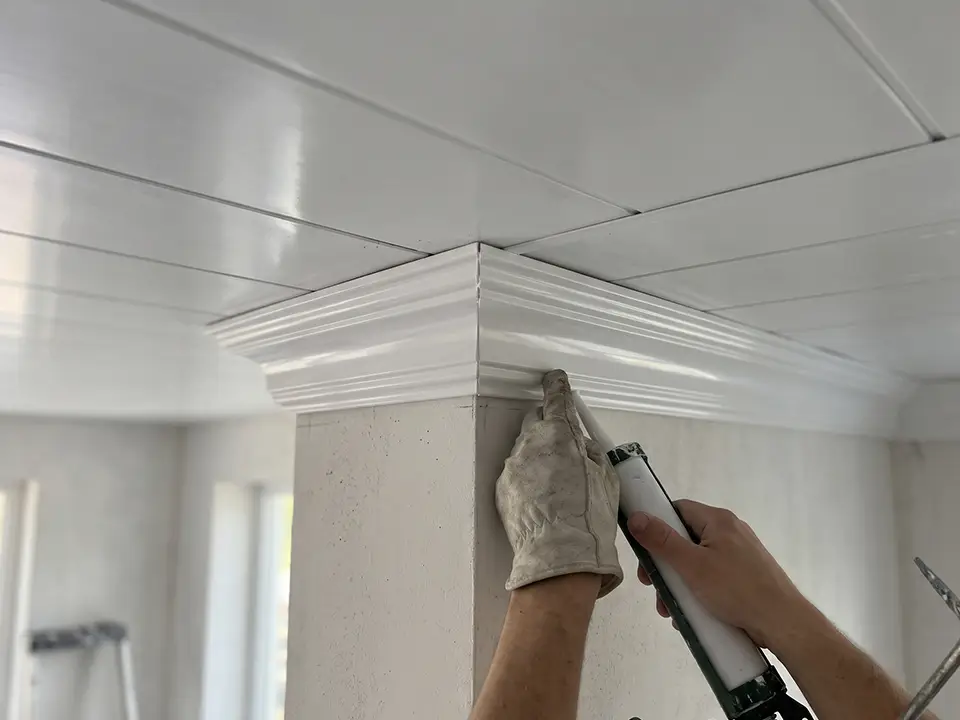
Even premium extruded moldings can fail visually or structurally if site conditions and thermal mechanics are ignored. Addressing common PVC ceiling trim installation problems quickly prevents callbacks for contractors and protects product reputation for distributors.
Below are the five most frequent on-site failures, their root engineering causes, and proven field fixes.
1. Perimeter Trim Buckling or Warping Into Waves
- The Symptom: Weeks or months after installation—especially when summer temperatures rise or indoor heating is turned on—the straight perimeter J-trim or cornice bows outward in visible waves.
- Root Cause: PVC has a linear thermal expansion coefficient of approximately 0.06 to 0.08mm/m/°C. Across a 5-meter wall experiencing a 25°C seasonal temperature swing, the trim expands by 7.5mm to 10mm. Buckling occurs when installers butt trim ends tightly into corners with zero clearance, or drive screws so tightly against the flange that the profile cannot slide.
- How to Fix & Prevent: Leave a 2mm expansion gap where non-mitered J-trims meet inside corners. Fasten screws through the center of elongated nailing slots, leaving 0.5mm play under the screw head so the vinyl can glide horizontally. Never glue both the trim and the ceiling panel rigidly together inside the receiving slot.
2. Open Gaps at 45-Degree Mitered Cornice Corners
- The Symptom: The two halves of an inside or outside hollow cornice corner fail to meet flush, leaving an unsightly dark gap at the top or bottom edge.
- Root Cause: Masonry and drywall room corners are rarely true 90-degree angles (often measuring 87° to 93°). Additionally, cutting hollow multi-chamber profiles too fast with a coarse saw blade causes the unsupported front profile face to deflect inward during the cut.
- How to Fix & Prevent: Measure the actual corner angle with a digital angle finder and divide by two (e.g., an 88° wall corner requires two 44-degree cuts, not 45°). Insert a scrap wooden support block inside the hollow cornice cavity right at the cut line to keep the profile walls rigid under the saw blade.B2B Solution: Supply injection-molded 90-degree internal and external corner blocks (end caps) with your cornice systems. This allows installers to make simple 90-degree straight cuts that slide into the corner cap with zero mitering required.
3. Ceiling Panels Slipping Out of the Trim Channel
- The Symptom: The cut ends of the PVC ceiling panels drop down out of the J-trim or cornice slot along one side of the room.
- Root Cause: Panels were cut too short during warm weather and contracted past the 12mm front lip during winter; OR the first furring batten was installed too far (>200mm) from the perimeter wall, allowing the cantilevered panel end to flex downward under gravity.
- How to Fix & Prevent: Always install a dedicated perimeter furring batten right alongside the wall so the panel end is screwed down within 50mm of the trim channel. Specify deep-channel trims (18mm–22mm front lip) for commercial rooms over 4 meters wide.
4. Visible Gaps Between Rigid Trim and Wavy Masonry Walls
- The Symptom: When installed against uneven brick, stone, or hand-troweled plaster walls, rigid PVC trim bridges across the high spots, leaving shadowy gaps up to 8mm wide along the low spots.
- How to Fix & Prevent: Score the back structural ribs of the nailing flange every 100mm at shallow curves so the trim conforms slightly to gentle wall contours (without kinking the front lip). Apply paintable neutral-cure acrylic or MS polymer sealant along the top wall-to-trim junction. Specify co-extruded flexible soft-lip trims designed specifically for uneven substrates.
5. Flange Cracking When Shooting Staples or Nails in Cold Weather
- The Symptom: The rear fastening flange shatters or splits radially around the staple crown during winter installations.
- Root Cause: Below 5°C (41°F), thermoplastics become significantly stiffer. If the trim uses a high-filler formulation (>55% CaCO3 with insufficient CPE impact modifier) or the pneumatic stapler air pressure is set too high (>90 PSI), impact fractures occur.
- How to Fix & Prevent: Store PVC trims in a heated room ( 15°C+ ) for 24 hours prior to winter installation. Dial pneumatic crown staplers down to 60–70 PSI or switch to pre-drilled pan-head screws.
Quick Troubleshooting Matrix
| Problem | Primary Culprit | Immediate Field Fix |
|---|---|---|
| Wavy / Buckling Trim | Over-tightened screws / No expansion gap | Back screws out 1/4 turn; trim 3mm off end joint |
| Gapping Miter Corners | Out-of-square walls (not 90°) | Adjust miter saw angle using digital protractor; use corner caps |
| Panels Dropping from Slot | Panels cut >10mm short / Missing perimeter batten | Center panel lengthwise in channel; add mechanical clip |
| Cracking Nailing Flange | Cold temperature + high staple gun PSI | Reduce compressor PSI to 65; pre-warm trims indoors |
- Prevent cracking by choosing the right resin ratio—read How to Choose PVC Ceiling Trim.
- Review the correct fastening sequence in our PVC Ceiling Trim Installation Guide.
Eliminate Contractor Callbacks with High-Impact PVC Formulations
Tired of brittle trims that crack on site? Our virgin-resin impact-modified PVC ceiling trims are tested for cold-weather stapling and supplied with optional injection-molded corner caps.
Request a Sample Pack to Test Our Toughness.
Frequently Asked Questions
Why is my PVC ceiling trim buckling or waving on the wall?
PVC trim buckles when fasteners are driven too tightly against the nailing flange or when trim ends are butted tightly into corners without thermal expansion clearance. Back screws out by a quarter-turn and leave a 2mm–3mm expansion gap at non-mitered ends.
How do I fix gaps in 45-degree mitered PVC cornice corners?
Most room corners are not true 90-degree angles. Measure the exact wall angle with a digital protractor and divide by two before cutting, or use injection-molded 90-degree internal and external PVC corner caps that conceal straight cuts without mitering.
Why are my PVC ceiling panels slipping out of the perimeter trim?
Panels drop out of the slot if they were cut more than 10mm short or if the first furring batten was mounted too far (>200mm) from the wall. Install a perimeter batten within 50mm of the wall and use deep-lip (18mm–22mm) trims for wide rooms.
How do you stop PVC trim from cracking when stapling in winter?
Acclimate PVC trims indoors at 15°C (60°F) for 24 hours before installation, reduce pneumatic staple gun air pressure to 60–70 PSI, and source impact-modified trims compounded with at least 50% virgin PVC resin and CPE modifiers.