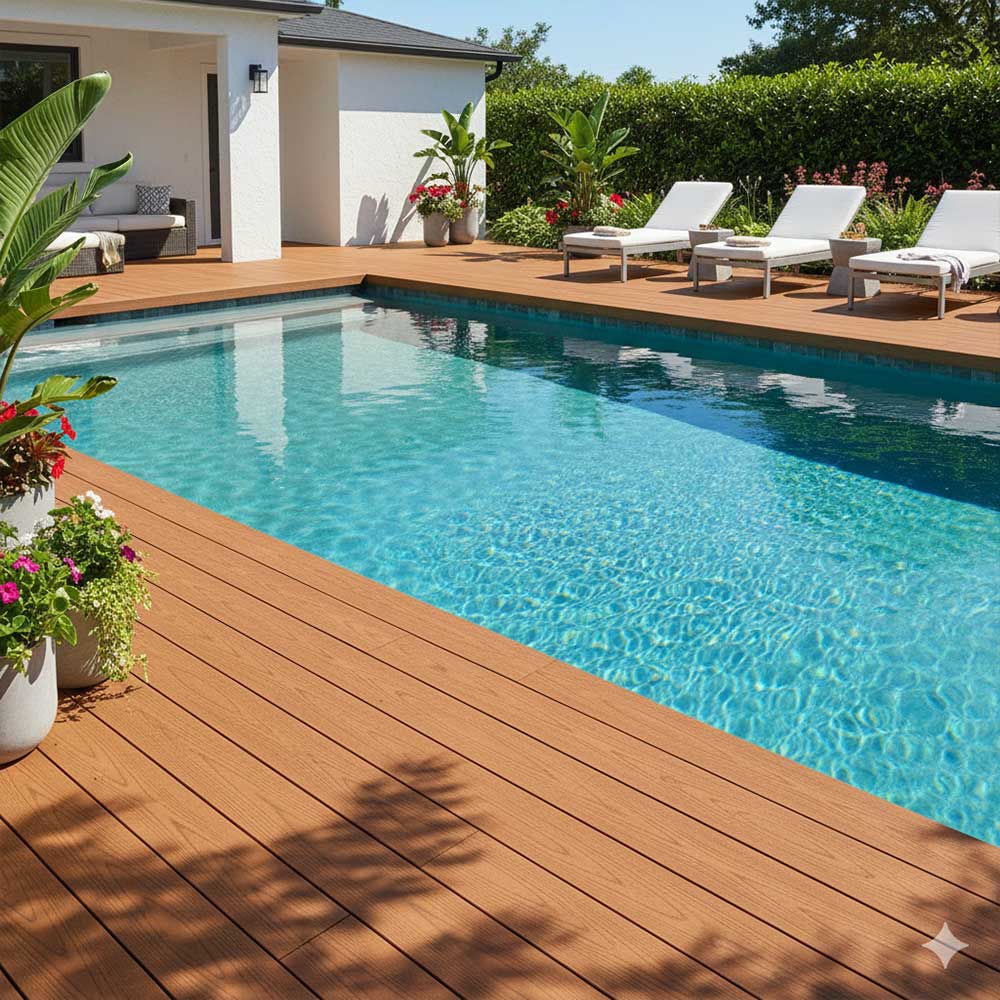
The production process of WPC (wood-plastic composite) flooring mainly consists of six core stages: raw material pretreatment, mixing and plasticizing, extrusion molding, cooling and shaping, cutting and processing, and surface treatment. While there may be slight differences depending on the production equipment and processes, the overall process remains consistent. The specific steps are as follows:
1. Raw Material Pretreatment
Main raw materials: PVC resin powder (or recycled PVC material), plant fibers (wood flour, bamboo flour, etc.), calcium carbonate (filler), plasticizer, stabilizer, carbon black (colorant), etc.
Pretreatment steps:
Crushing and grinding: Crushing and grinding PVC waste or virgin material into powder.
Drying: Plant fibers need to be dried until the moisture content is below 2% to avoid air bubbles during extrusion.
Surface modification: Some fibers or calcium carbonate undergo coupling agent treatment to improve compatibility with plastics.
2. Mixing and Plasticizing
Mixing Stage: The pretreated raw materials are fed into a high-low mixing unit (such as the 500/1000 high-low mixing unit) according to the formula ratio. First, high-speed stirring (approximately 10-30 minutes) is used to evenly disperse the materials, followed by low-speed cooling to prevent agglomeration.
Plasticizing Stage: The mixed material is fed into a twin-screw extruder (such as the Saiwang production line, which uses twin-screw technology), where it is melted and plasticized at a high temperature of 160-180℃ to ensure thorough integration of the raw materials.
3. Extrusion Molding
Die Extrusion: The molten material is extruded through a dedicated floor die to form a continuous floor substrate.
Co-extrusion Process (Optional): Some production lines use co-extrusion technology to coat the substrate surface with a wear-resistant or decorative layer (such as the co-extrusion Great Wall panel process).
4. Cooling and Shaping
Vacuum Shaping: The extruded flooring substrate enters a vacuum shaping table, where it is rapidly shaped using negative pressure adsorption and a cooling system (such as circulating water cooling) to ensure dimensional accuracy and flatness.
Cooling Rack: After shaping, the flooring is further cooled by a cooling rack to prevent deformation.
5. Cutting and Processing
Longitudinal Cutting: The sides of the flooring are cut using a longitudinal cutting machine according to width requirements.
Transverse Cutting: Continuous flooring is cut to length using a traction machine and a transverse cutting machine.
Click-locking Processing: Some production lines are equipped with automatic grooving equipment to process click-locks (such as Click-locks) on the edges of the flooring, enabling glue-free installation.
6. Surface Treatment and Packaging
Surface Decoration: Wood grain treatment (such as heat transfer printing, embossing) or coloring gives the flooring a wood or stone-like texture.
Quality Inspection: Check dimensions, appearance, locking strength, and other indicators.
Packaging and Warehousing: Finished products are received by a robotic arm and then packaged for warehousing and sale.
Key Equipment and Technical Features:
Core Equipment: Crusher, grinding mill, mixing unit, twin-screw extruder, vacuum forming table, cutting and grooving equipment.
Technical Advantages:
Automation: Fully automated operation, reducing manual intervention.
Environmental Protection: Uses recycled plastics and plant fibers, reducing wood consumption.
Performance Optimization: Improves the flooring’s resistance to deformation and wear through formula adjustments (such as adding attapulgite powder).
Differences Between Different Processes:
Molding Process: Some companies use molding instead of extrusion, using hot pressing to improve the flooring’s density and stability.
Co-extrusion process: A wear-resistant or decorative layer is co-extruded onto the substrate surface to enhance product durability and aesthetics.